
Hoist assembly fell from bridge crane and nearly struck worker
Date of incident: May 2022
Notice of incident number: 2022194080013
Employer: Sawmill
Incident summary
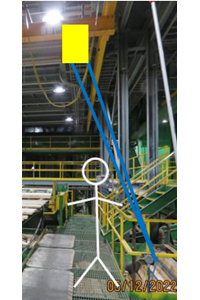
Workers at a sawmill were using a 1-ton overhead bridge crane to install a new chain on a strip unscrambler (a machine used to move wood strips from one conveyor to another). The hoist assembly (hoist motor, drum, and wire rope) came off the end of the crane’s bridge rail and fell approximately 5 m (16 ft.) into the work area, nearly striking a worker.
Investigation conclusions
Cause
- Hoist assembly was pulled off because crane was side-loaded. Workers side-loaded the crane (positioned the load with its centre of gravity not directly under the hoist) while using the crane to position the replacement chain on the unscrambler. The chain bound (caught) on a sprocket of the unscrambler and the tension on the load line overcame the resistance of the end stop on the bridge rail.
Contributing factors
- Inadequately planned and constructed workplace.
- Overhead bridge cranes were being used contrary to the manufacturer’s instructions, the Occupational Health and Safety Regulation, and the requirements of CSA Standard B167-96 Safety Standard for Maintenance and Inspection of Overhead Cranes, Gantry Cranes, Monorails, Hoists, and Jib Cranes. The selection and installation of the overhead bridge cranes in the areas of the log bin, slasher saw, and debarker areas of the sawmill did not adequately consider how the cranes would be used or ensure they were fit for the intended purpose.
- Despite the fact that regular maintenance was required on the unscrambler, neither a crane nor a dedicated location to affix a manual hoist was available to service the unscrambler. Some maintenance tasks on the unscrambler require the movement of heavy tools or equipment (e.g., the unscrambler chain weighed 136 kg (300 lb.)). The unscrambler is not readily accessible from the production area of the mill’s second floor. Access to and egress from the unscrambler pit is difficult and worker positioning in the unscrambler conveyor is awkward.
-
Inadequate instruction, training, and supervision.
- Adequate instruction and training in the use of cranes had not been provided. Training for crane use did not include manufacturer’s instructions, regulatory requirements, or the requirements of CSA Standard B167-96.
- Job safety analyses (JSAs) were generic and did not address the hazards specific to the task of repairing the unscrambler. No supplemental information or instruction was provided to workers related to the task, and neither the supervisor nor the chargehand attended the job while it was underway.
- The repeated misuse and side-loading of overhead bridge cranes was not sufficiently recognized or addressed.
- The side-loading of cranes had become a normalized practice, which likely influenced the decision by workers to side-load the crane.
Other health and safety issues
- Inadequate correction of unsafe conditions. The service records and records of inspection of cranes used in the log bin, slasher saw, and debarker areas of the sawmill revealed multiple, persistent deficiencies. This indicated that the cranes were being misused and defects were not being adequately recorded, reported, investigated, and corrected.
- Ineffectively implemented safety management system. The employer has a safety management system (SMS). Deficiencies in the implementation of several elements of the SMS, however, had diminished the resilience of the system and the employer’s ability to identify hazards and control risks in its workplace.
data-bs-keyboard="true">
2021-04-22 20:42:33