
Does the performance of commonly used respirable and inhalable aerosol samplers enable adequate collection of workplace metals to meet occupational exposure limits?
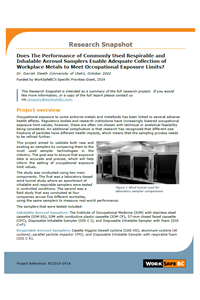
This study aimed to validate novel and existing samplers against widely-used technologies in industry to ensure precise exposure data, ultimately informing occupational exposure limit values. Both laboratory and field studies were conducted at multiple sites, testing inhalable and respirable samplers. In the laboratory, the Inhalable Occupational Monitor with Conductive Plastic Cassette Insert (IOM CP) performed best for inhalable dust, with the Inhalable Occupational Monitor with Stainless Steel Cassette Insert (IOM SS) closely following. The Closed Faced Cassette (CFC) sampler underperformed, while the Disposable Inhalable Sampler (DIS CI) showed potential. In field testing, both versions of the IOM (IOM SS and IOM CP) performed similarly, though the DIS samplers yielded higher concentrations, likely due to wall deposits and reduced sample loss. For respirable dust, the Parallel Particle Impactor (PPI) and Aluminum Cyclone (Al cyclone) under-sampled compared to the Casella Higgins Dewell Cyclone (CAS HD), while the DIS C R was more consistent. Despite methodological challenges, the study highlights the complexity of selecting a "standard" sampler and underscores the need for continued efforts to identify reliable and consistent samplers. Further research and standardization of testing protocols are crucial.
| Principal Applicant: | Darrah Sleeth (University of Utah) |
| Co-Applicants: | Martin Harper (University of Florida); Steven Verpaele (NiPERA Inc.); Michael Calosso (IRSST) |
| Funding Awarded: | $150,000 (Systematic Reviews/Specific Priorities) |