
Hedging roadside hazards in landscaping
Published on: September 22, 2025
Over the years, B.C.’s landscape industry has put in place workplace safety measures to protect roadside workers from traffic hazards and prevent serious injuries.
By Sarah Ripplinger
A fixture of the landscape industry in B.C. for over 35 years, Brian Ramor says he’s lucky to be alive.
“I feel grateful for what I’ve learned from colleagues and industry organizations, because I now know that there were likely a few times I came close to death when working by the side of the road,” Ramor says. “Over time, you realize that the problem you had in the past isn’t a problem today.”
With that shift in perspective, the owner and operator of Think Green Landscaping Ltd., Ramor, along with others in the landscape industry, have advocated for workplace safety to protect his workers from traffic hazards.
Between 2015 and 2024, nine roadside workers across all industries in B.C. were struck and fatally injured by motor vehicles. Another 267 workers were seriously injured and unable to work. In the landscaping, lawn, or garden maintenance industry, 207 claims that involved being struck by a land vehicle were filed with WorkSafeBC between 2020 and 2024. That accounts for 7.6 percent of the industry’s total claims for workers both inside and outside of vehicles.
From 2021 to 2023, the industry had about twice as many motor vehicle incidents as the average of all other industries combined.
“Landscaping is within the top six occupations with the highest number of workplace injuries due to workers being struck by motor vehicles,” says Trace Acres, program director for Road Safety at Work. “Most of these incidents are avoidable.”
Meeting employer responsibilities
Employers are responsible for ensuring a safe workplace for their employees. They are required to ensure that effective control measures are provided and implemented whenever traffic could be hazardous to workers. To do this effectively, employers must identify the factors that contribute to risk in the workplace, assess them to determine the degree of risk to workers, and provide effective controls to eliminate or mitigate the risk. Roadside safety requirements for employers are set out in:
- Part 18 (Traffic Control) of the Occupational Health and Safety Regulation
- The B.C. Ministry of Transportation and Transit Traffic Management Manual for Work on Roadways
“Employers should ensure their workers understand safety information and follow guidelines in the workplace,” says Acres. Road Safety at Work offers employers detailed, practical information based on these two resources. Its work zone safety information includes risk assessment, site planning and orientation, and training tools.
“Road Safety at Work also provides risk assessment workshops to employers three times per year,” Acres adds.
Building a safety culture
As head of Blue Pine Enterprises Ltd., a landscape construction company, Mike Lalonde champions ongoing communication and training.
Since its inception in 2000, Blue Pine has grown to over 200 full-time staff in the Lower Mainland and on Vancouver Island. The company specializes in full-service landscape construction — such as fencing, gates, paving stones, retaining walls, and irrigation systems.
“We promote a safety culture,” says Lalonde, who sits on the board of the British Columbia Landscape and Nursery Association (BCLNA). “Our new hires go through a half-day orientation with our safety team lead that covers what hazards to watch for and things like that.”
“The more that workers hear safety messages, the more it becomes second nature,” Lalonde says. “It comes down to creating good habits and promoting safety.”
Assessing roadside risks
Risk assessments must be performed for each worksite, even when staff attend multiple sites during a workday.
“To prevent struck-by incidents, employers must first identify where vehicles operate close to workers — especially in tight or narrow workspaces,” says Catherine Hunchak, an industry and program specialist with WorkSafeBC. “Employers need to conduct a risk assessment at every location to identify hazards, assess risks, and determine appropriate controls.”
“Every morning, we go over findings from our site-specific risk assessment,” says Lalonde. Site-specific risk assessments detail what hazards have been identified and corresponding control measures put in place to reduce the risk of injury to workers at each site. Forepersons and supervisors are on Blue Pine’s worksites to educate workers on the risks of struck-by incidents and ensure that effective measures are taken.
Whether it’s due to rain creating slip hazards or nearby construction increasing the risk from trucks and heavy machinery, risk assessments must account for changing site conditions.
“Full-site risk assessments give employers the information they need to put in place the necessary plans and protections to reduce safety risks,” Acres affirms.
Controlling for traffic
Traffic control considerations for all jobs can be viewed through the lens of job duration. For landscaping jobs lasting 15 minutes or less, employers must comply with the requirements for brief-duration work set out in section 18.3.1(2) of the Regulation where written work procedures must be prepared. For jobs lasting more than 15 minutes (short- or long-duration work), employers must develop and implement a written traffic control plan, as laid out in section 18.3.2 of the Regulation.
Blue Pine’s jobs often span several days to weeks. By contrast, landscape-maintenance and renovation companies like Think Green can have teams of about eight full-time staff travelling to multiple sites over the course of a workday. Think Green has been in business for more than 30 years. Its services range from lawn care and garden maintenance to seasonal displays. Employees travel for work across Greater Vancouver, with jobs reaching as far as Squamish and Hope.
Many worksites are located on roadway boulevards or shoulders, placing workers in close proximity to traffic where safety needs to be a top priority. The most effective way to reduce the risk of struck-by incidents is to design the work and the worksite to eliminate or limit interactions between workers and vehicles. This means following the hierarchy of controls and putting in place a combination of elimination, substitution, engineering, and administrative controls, along with the use of personal protection equipment.
“The key to preventing struck-by incidents is to plan the work, identify hazards, assess risks, and implement effective controls to manage workervehicle interactions,” Hunchak explains. “Often, a combination of controls is needed.”
Employers should prioritize safety measures that separate workers from vehicle traffic. Examples include using physical barriers or scheduling work to occur in low-traffic periods.
If an employer cannot remove traffic hazards and isolate workers from the risks of an active roadway or substitute hazardous work, they must implement measures that minimize workers’ exposure to traffic.
“Whenever possible, flashing amber lights should be activated when landscape workers are present at the roadside,” Acres says.
Under B.C.’s ”slow down, move over” traffic law, flashing amber lights require that drivers on a roadway with a maximum speed limit lower than 80 kilometres per hour slow down to 40 km/h. On a roadway with a speed limit of 80 km/h or higher, drivers must slow down to 70 km/h.
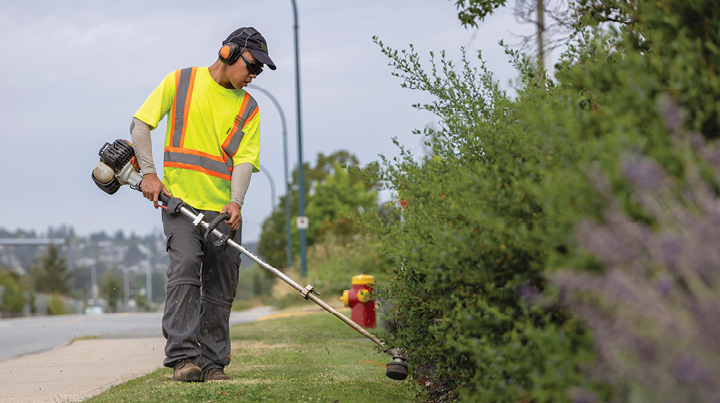
As part of an employer’s administrative control measures, setting up a safety cone perimeter can also be effective for some types of worksites. So is wearing high-visibility personal protective equipment like safety vests.
“The motto I tell my crew all the time is, ‘Live behind the cones,’” Ramor says. “I tell my crews to always bookend the worksite with cones. This means taking the cones with them as the worksite moves.”
Eliminating distractions
At a recent Road Safety at Work forum for landscape professionals, industry representatives flagged managing worker distractions as a major safety priority.
Talking on the phone or using earbuds or noisecancelling earphones is absolutely banned from Ramor’s worksites. This prohibition is discussed at the company’s regular toolbox talks.
“Workers need hearing protection from loud machinery, but they still need to hear stuff like someone yelling for them to get out of the way of a vehicle,” Ramor explains. “Noise-cancelling technology means they can’t hear anything, and that’s an absolute ‘no’.”
“I always tell my staff that I never want to have to call their family,” Ramor says. “Everybody should have the chance to go home for dinner.”
For more information
Learn more by searching at worksafebc.com for “working in and around traffic,” “assessing risks,” and “controlling risks.” Visit RoadSafetyatWork.ca for more information about safe work by the roadside.
This article originally appeared in the Fall 2025 issue of WorkSafe Magazine.
To read more or to subscribe, visit WorkSafe Magazine.