
Understand combustible dust hazards
For employers and supervisors:
This information will help you lead a toolbox talk or safety meeting.
Before you talk to workers, think about how to include details about your workplace. For example, be prepared to discuss:
- Which materials can become combustible dusts
- What type of work processes can turn materials into combustible dust
- Where combustible dusts typically build up in your workplace
- How dusts can combust
- What causes a combustible dust explosion
- What workers can do to reduce the risk of a combustible dust fire, deflagration, or explosion
Combustible dust is a serious workplace hazard that’s easy to overlook. Fine particles from materials like wood, metal, grain, or plastic may be combustible.
Any workplace that generates or handles combustible dusts has a risk of fire or explosion.
What combustible dust is and where it comes from
Most dusts are combustible. This means they can easily catch fire and burn if they’re exposed to an ignition source. A spark, hot equipment, or static electricity can light the dust on fire.
Combustible dusts come from many materials people work with. There are three categories of materials that combustible dusts come from:
- Organic, such as wood, grain, paper, lint, plastics, and rubber
- Metallic, such as aluminum, nickel, iron, and titanium
- Chemical, such as pesticides and pharmaceuticals
Grinding down, cutting up, or crushing materials into fine particles can make combustible dusts. Mixed materials or compounds can also make combustible dusts.
How combustible dusts catch fire
Some combustible dusts can catch fire when they build up on surfaces and are exposed to an ignition source. For example, this can happen on rafters, ledges, and equipment.
Other combustible dusts can catch fire when they’re suspended in the air and are exposed to an ignition source. For example, a dust cloud can catch fire if it comes in contact with a spark.
What makes combustible dusts so dangerous
Combustible dusts can lead to a fire or explosion. This can happen if dust builds up in our workplace and is exposed to an ignition source.
The risk can increase very quickly. It depends on the type of dust, how much there is, and where it is.
There are different types of dust fires:
- Fire. Dust burns like any other fuel when it’s exposed to an ignition source and oxygen.
- Flash fire. Fine dust suspended in the air can catch fire. The fire burns rapidly through the dust cloud.
- Deflagration. A flash fire inside a closed-in space (such as a room, silo, or piece of equipment) causes dangerous air pressure to build up quickly.
- Explosion. An explosion happens when the pressure from a deflagration builds up enough to burst through the enclosed space. Explosions can cause injuries through fire, the force of the pressure release, or flying debris.
What causes combustible dust explosions
An explosion can happen when the five basic conditions of the “dust explosion pentagon” are present.
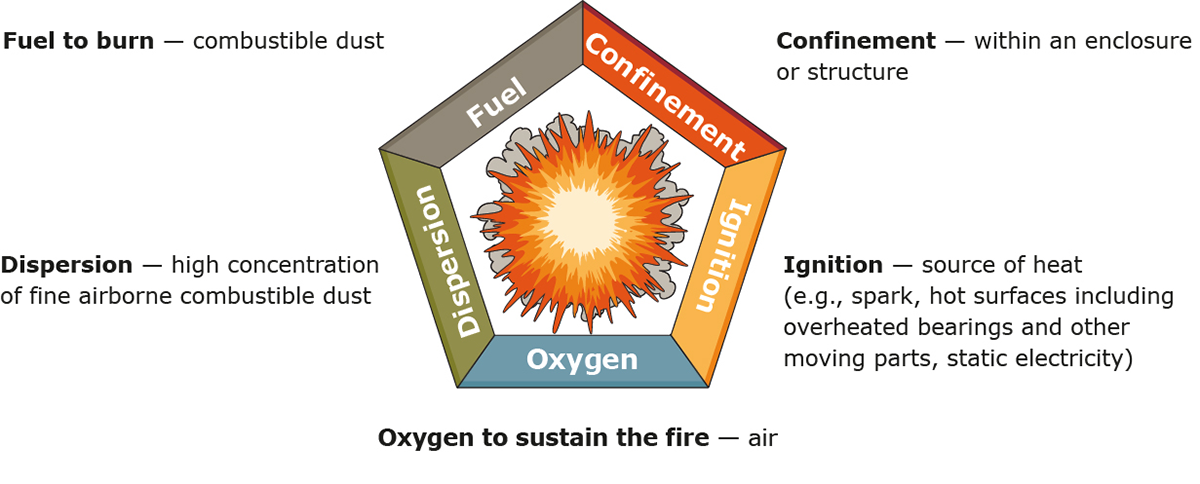
An explosion is likely to happen when a lot of combustible dust becomes airborne and makes contact with an ignition source in a confined area.
A diagram showing the five conditions for a combustible dust explosion: fuel, dispersion, oxygen, ignition, and confinement.
- Fuel to burn: The combustible dust itself
- Dispersion: A high concentration of fine dust in the air
- Oxygen: Enough oxygen in the air to feed the fire
- Ignition: A source of heat or energy, such as a spark, a hot surface, overheated equipment, or static electricity
- Confinement: A closed-in space where pressure can build, such as a building, silo, or piece of equipment
Removing any one of these five conditions reduces the risk. But it may not eliminate it. That’s why our workplace’s combustible dust management program includes more than one way of controlling the risk.
How to reduce the risks
Here’s what you can do:
- Take part in education and training on our combustible dust management program.
- Follow the dust management program. This includes procedures for dust cleanup, hot work, and maintaining machinery and equipment.
- Report dust buildups to your supervisor.
- Report ignition sources in areas where dust has built up.
Related information
- Spot and report combustible dust hazards (toolbox talk)
- Safe cleanup methods for combustible dusts (toolbox talk)
- Metal dust hazards and cleanup methods (toolbox talk)
Find more information at worksafebc.com/combustible-dusts. You can download a meeting record template at worksafebc.com/meeting-record.