
Making a difference in health and safety — one workplace at a time
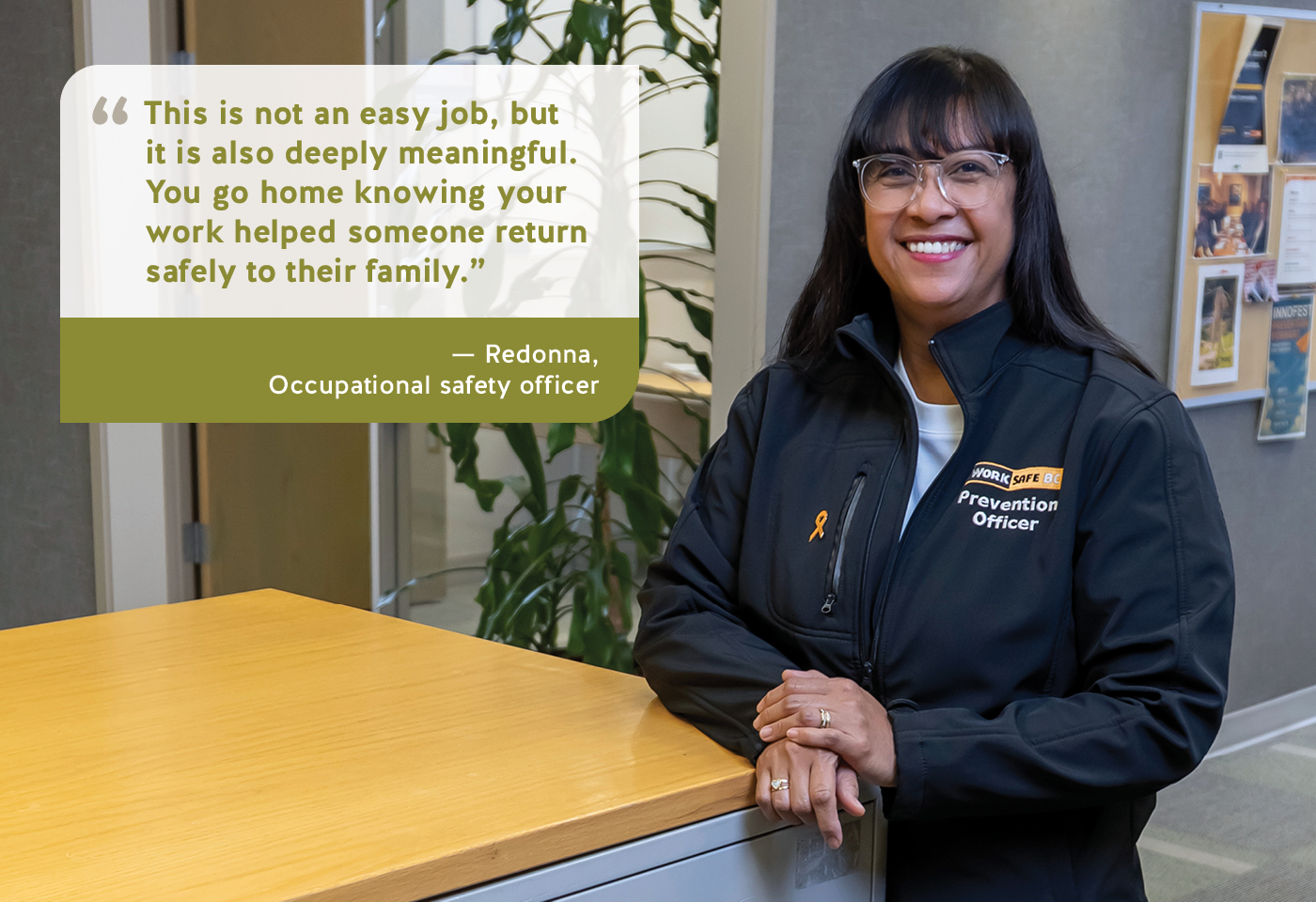
Meet Redonna
Redonna, an occupational safety officer who specializes in psychological health and safety, works in some of the most complex workplaces in the province. She describes her role as challenging — but incredibly worthwhile.
Every day across B.C., workers encounter a wide range of hazards, from moving vehicles and heavy equipment to violence, fatigue, and psychological strain. Supporting employers and workers in addressing these hazards is the work of occupational safety officers (OSOs), who serve as the front line of our Prevention Field Services team.
For Redonna, who has been an OSO with WorkSafeBC since 2013, that responsibility is deeply personal. Redonna works primarily in health care and social services, with a specialized focus on psychological health and safety. She engages with some of the most complex and emotionally demanding workplaces in the province. Her work spans Downtown Vancouver, the Downtown Eastside, North Vancouver, and West Vancouver, where she supports workers, employers, unions, and communities in navigating both physical and psychological workplace health and safety.
“I’ve worked in occupational medicine since I was 18, so this work has always been close to my heart,” says Redonna.
A path shaped by lived experience
Redonna began her career in California, working in occupational medicine as a medical assistant. But her commitment to workplace health and safety began even earlier. When she was a child, her father survived a serious work-related electrical accident. Later, as a teenager working at a restaurant chain, she suffered a severe burn on the job.
“Those experiences stay with you,” she says. “I saw first-hand what workers go through, and how easily injuries can happen when protections aren’t in place. I knew I wanted to be in a field where I could help prevent that.”
After moving to B.C. in 2007, Redonna completed the Occupational Health and Safety program at BCIT and joined WorkSafeBC through a summer placement in 2012. A year later, she became a full-time OSO.
Training that helps you thrive
One of the first things Redonna noticed when she joined WorkSafeBC was the depth of support and training provided before she began working independently in the field. The comprehensive New Prevention Officer Development (nPOD) program, which combines classroom learning, mentorship, and hands-on experience, is designed to set new officers up for success from day one.
The nPOD training pairs new officers with experienced mentors and continues beyond the first year through ongoing learning and professional development. Redonna later became a mentor herself and helped shape the Prevention Field Services’ mentoring program at a provincial level.
“This job is lifelong learning,” she says. “Even after 12 years, I’m still learning every single day.”
Work that’s challenging — and deeply worthwhile
Redonna’s role has involved working with employers on safety improvements, including in complex care environments where violence, trauma, and resource pressures intersect.
Her responsibilities also include participating in an on-call rotation to assist when urgent situations arise, such as a serious injury or death. While these situations can be challenging, OSOs have a lot of resources to support them during these times, including working closely with supervisors, colleagues, and specialized teams.
She also speaks candidly about the difficulty of working in male-dominated industries and the resilience required to be heard as a woman of colour.
“You have to work harder to get people to listen, especially when they’ve been doing a job the same way for decades,” she says. “But I’ve been fortunate to work with leaders who consistently tell me, ‘We trust you. Tell us what you need and how we can help.’ Hearing that builds confidence. It tells me it’s okay to ask for support, to speak up, and to know I’m not navigating this work alone.”
For Redonna, the rewards of the role outweigh its challenges. She finds the most fulfilling part is the opportunity to connect with workers and employers and support them in creating safer workplaces. Progress can be slow, she says, but even incremental change matters.
“It’s the phone calls and emails from a worker or an employer, saying ‘thank you,’” she says. “Those small wins mean everything. It’s one worker at a time, one employer at a time. That’s how real change happens.”
Why this work matters
Today, Redonna is on secondment with WorkSafeBC’s Worker Rights and Systems Integrity team, supporting complex investigations while continuing to serve as a subject matter expert in health care and social services. Yet her passion remains rooted in field work and direct engagement.
“This is not an easy job,” she says. “But it is also deeply meaningful. You go home knowing your work helped someone return safely to their family.”
For those considering a career as an OSO, she offers three simple but powerful pieces of advice: Be honest, stay organized, and never stop learning.
To learn more about becoming an occupational safety officer and to explore current opportunities in Prevention Services, visit our Careers page.
Videos
- Meet Joti, an occupational safety officer at WorkSafeBC
- Meet Sanjesh, an occupational hygiene officer at WorkSafeBC