
Choose a respirator
As an employer, you’re responsible for choosing respirators for your workers. Respirators must protect workers from the hazards in the air and meet each worker’s needs.
You must consult the workers who will wear a respirator, as well as your joint health and safety committee or worker health and safety representative, if you’re required to have one.
Respirators must be selected, used, and maintained following CSA Standard Z94.4-18 Selection, Use, and Care of Respirators.
Choosing the right respirator is a technical process. This page helps you prepare for the process and know what you need to do after.

For step-by-step instructions on choosing a respirator, consult Breathe Safer: How to Use Respirators Safely and Start a Respirator Program.
Knowledge required
Before you choose, get clear on these factors:
- What type of contaminants are in the air at your workplace, and how much of each there is.
- Exposure limits for those contaminants. Look them up with the E-Limit search tool.
- Which work areas, if any, could become low in oxygen or immediately dangerous to life or health (IDLH).
What you need
- Breathe Safer, Part 2.
- Safety data sheets for the products your workers use.
- Air monitoring results.
- CSA Standard Z94.4-18. Find out how to access CSA standards.
Involve workers from the start
You must consult the worker who will wear respirator. You must also consult your joint health and safety committee or worker health and safety representative. You’re responsible for making the decision, but you should take workers’ input into account.
Start early. This will give you time to consider feedback before decisions are final. Good consultation means you:
- Share information about breathing hazards and respirator options.
- Let workers try more than one make, model, and size, so each worker can find one that fits and is comfortable.
- Ask about the impacts of wearing the respirator on:
- Comfort
- Ease of breathing
- Vision
- Talking and moving
- Give workers and their representatives a chance to share input, including about their own needs.
- Listen to questions and concerns, and consider them before making a final decision.
Consider each worker’s needs
A respirator that works for one worker may not work for another. Think about the work itself, such as:
- How long the respirator will be worn
- Possible heat stress
- Physical effort
- Whether workers need to talk or see clearly
Also think about other PPE worn at the same time, like hard hats, safety eyewear, and hearing protection.
Some workers may need a different type of respirator because of:
- A medical condition that affects respirator use
- A facial injury or medical treatment that affects fit
- Facial hair kept for religious or medical reasons
- Anything else that could interfere with the seal, such as:
- Prescription glasses
- Facial piercings
- Other PPE
Talk with workers about possible solutions. A loose-fitting respirator may work if it gives enough protection. If no respirator meets the worker’s needs, even if it gives the protection needed, you may need to assign them other work.
If a worker has a medical condition that may make it unsafe to wear a respirator, refer to Get workers medically assessed to wear a respirator.
Confirm that a respirator is needed
A respirator doesn’t remove the hazard. It only reduces exposure. The worker will be exposed if a respirator fails, isn’t worn properly, or isn’t right for the task.
Before you rely on respirators, you should work through the hierarchy of controls. You can rely on respirators as the main control only when:
- Other controls aren’t practical.
- Other controls can’t lower exposure enough.
- The exposure comes from temporary or emergency conditions.
Refer to When a respirator is required.
Follow the selection process in Breathe Safer
If you choose the wrong respirator, workers won’t be protected and could be seriously harmed or killed.
Work through all 13 steps of the selection process in Breathe Safer. Use the respirator selection flow chart as you go. Record what you find on the selection information form.
The process helps you:
- Identify breathing hazards, including low oxygen and emergencies.
- Find out how much of each contaminant is in the air.
- Compare those levels with exposure limits, and check whether they’re high enough to be IDLH.
- Work out how much protection workers need.
- Choose the type of respirator and the right filter or cartridge.
- Consider special requirements, such as comfort, other PPE, and the work itself.
Situations that require specialized processes:
- Bioaerosols, radiological or nuclear materials, or chemicals not covered in Breathe Safer: Follow CSA Standard Z94.4-18.
- Respirators used only for escape: Refer to the section on escape respirators in Breathe Safer.
Make sure the respirator is approved
Use only respirators that meet a standard acceptable to WorkSafeBC. Look for CSA or NIOSH approval on the label. NIOSH approval numbers start with “TC.”
WorkSafeBC also accepts some respirators with other approvals. Refer to G8.33(2)-1 of the OHS Guidelines or contact WorkSafeBC to find out if a respirator is acceptable.
Single-strap dust masks and surgical masks don't meet WorkSafeBC's requirements. They aren't respirators.
Meet your responsibilities after choosing
Be sure the respirators you’ve chosen are:
- Appropriate for the hazard
- At no cost to workers
- Available in enough sizes and models that each worker gets one that fits and is comfortable
Remember:
- If a respirator causes an allergic or other harmful reaction, provide another option.
- Before a worker uses a tight-fitting respirator, make sure they’re fit tested. Refer to Fit testing for respirators.
- Make sure workers are trained. Refer to Set up a respirator program.
- Ask workers regularly how their respirators are working. If something changes, think again about your choice.
Related resources
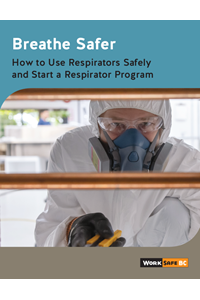
Breathe Safer: How to Use Respirators Safely and Start a Respirator Program
This book provides information on how to use respirators to protect workers from breathing hazards. Written for employers, supervisors, and workers, the book covers:
- Types of breathing...
Title
Please note: The content on this page is intended to help you understand and meet the requirements of the Occupational Health and Safety Regulation. More detailed information can be found in the OHS Guidelines and/or OHS Regulation.